

An HR practitioner mini course can provide focused, practical learning, but each program sets its own curriculum, duration, enrollment process, and materials. For HR teams, useful training connects procedures with sound judgment, employee rights, and workplace safety. Look beyond the course title and assess the skills it develops.
Before setting aside time for training, clarify what the course covers, how learning materials are provided, and how long it takes. Consider how employment law and safety fit into its practical content, then compare the learning outcomes with your team’s responsibilities. This helps you decide whether the HR practitioner mini course meets your development needs.
Key Takeaways
- Compare course coverage against your team’s needs, especially employment law, employee rights, workplace safety, and day-to-day HR practice.
- Plan learning time around the course’s stated duration, enrollment process, access period, and format of its materials.
- Assess whether the course level and prerequisites align with each participant’s experience and the responsibilities they handle.
- Use a structured employee-relations framework when a workplace concern calls for careful documentation and a consistent process.
Human resources practices and strategy
Effective HR practice connects daily decisions with organizational priorities. Start by identifying a recurring need, such as inconsistent onboarding or unclear performance feedback. Define the process, assign responsibility, and decide how to document each step. A manager checklist, for instance, can specify who conducts a first-week check-in and where agreed actions are recorded. This creates a repeatable structure while leaving room to respond to individual circumstances.
Course content should connect policy knowledge with practical work. One HR and payroll curriculum includes the Fair Labor Standards Act of 1938, also called the FLSA. Consider how employment rules inform routine processes, such as maintaining records or responding to a workplace concern. Templates can help teams apply learning consistently. Useful examples include an intake form for employee concerns, a meeting record, and a policy review checklist. Treat each template as a working aid, not a substitute for sound judgment or local legal advice.
How does a short course compare with SHRM-CP or PHR certification? A mini-course typically focuses on a defined topic, while certification is a separate professional credential. Compare the curriculum, assessment, eligibility criteria, and purpose of each before deciding which better fits your goals.
Choose a course by first naming the capability you want to build. A new practitioner may prioritize core HR processes, while an experienced employee-relations professional may need structured case-handling skills. Review the learning outcomes, exercises, and materials, then match them to a current responsibility or development plan.
For global HR teams, a shared framework can support consistent processes across locations. Local employment requirements and workplace norms still affect how policies are applied. Use a course to establish common principles, then adapt examples and templates to each country’s context. Reviewing policies across locations can reveal where a standard process needs local adjustments.
Do employers recognize these courses? Recognition varies by employer and role. A course can demonstrate focused learning, but it is not automatically equivalent to SHRM-CP or PHR. Show how you applied what you learned through a relevant work example, such as improving an onboarding checklist or documenting employee concerns consistently.
Course duration, enrollment, and learning materials
Compare the stated course length with the study time your team can set aside. Enrollment timing and access to materials also affect when participants can start applying what they learn.
Course Duration and Enrollment
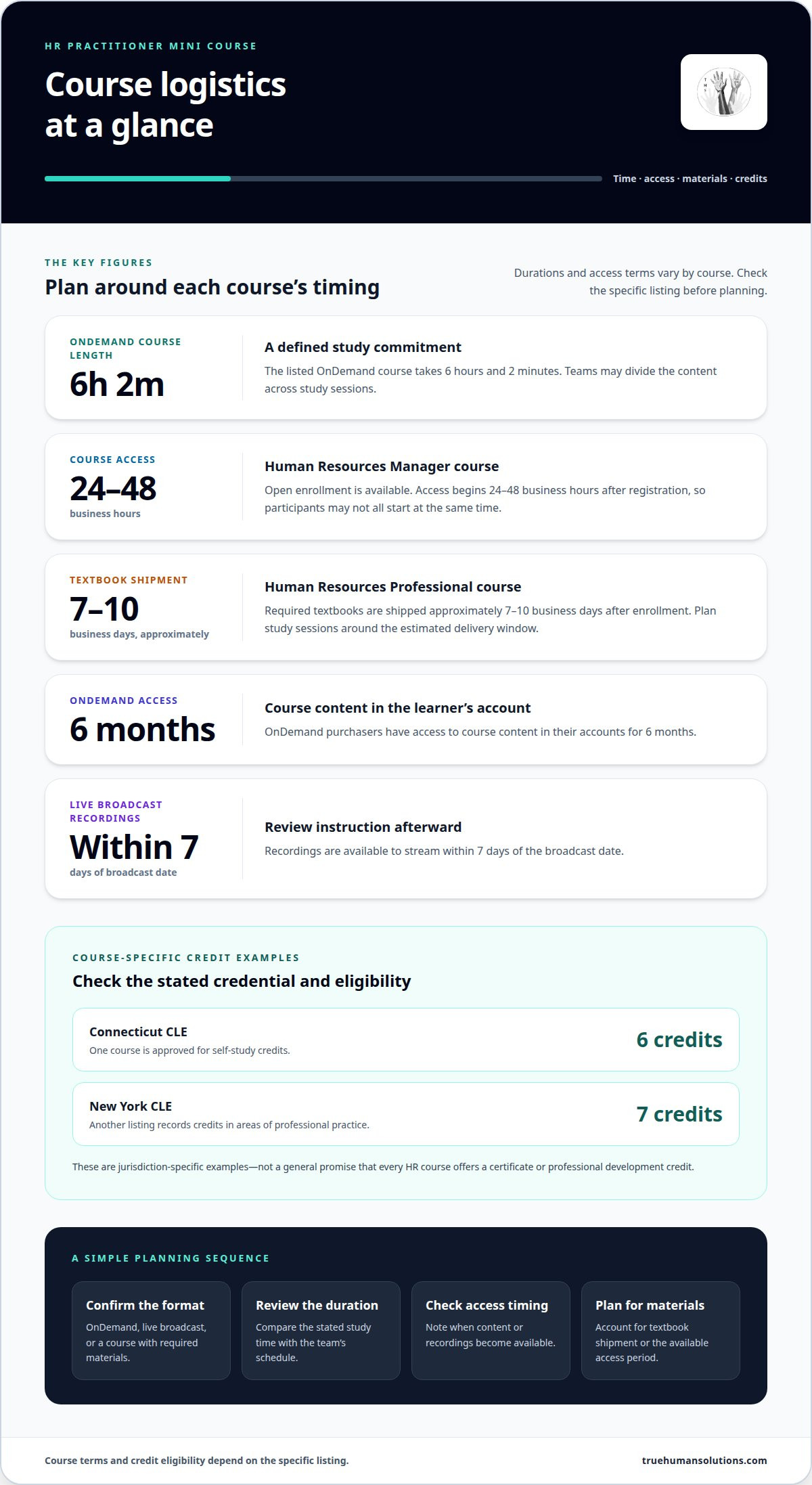
An OnDemand course is listed as 6 hours and 2 minutes long. This gives learners a defined study commitment, though teams may divide the content across sessions. The Human Resources Manager course uses open enrollment, with access available 24-48 business hours after registration. Check how the course format fits work schedules and whether access begins together for all participants.
Learning Materials and Credentials
Materials vary by course format. Required textbooks for the Human Resources Professional course are shipped approximately 7-10 business days after enrollment. OnDemand purchasers have access to course content in their accounts for 6 months. Recordings from live broadcasts are available to stream within 7 days of the broadcast date, giving learners another way to revisit instruction.
Do courses provide certificates or professional development credits? Credit depends on the specific course and approval. One course is approved for 6 Connecticut CLE self-study credits, and another listing records 7 New York CLE credits in areas of professional practice. These are jurisdiction-specific CLE credits, not a general promise that every HR course offers a certificate or professional development credit. Review the stated credential and its eligibility before enrolling.
Before registering, note the sequence: confirm the format, review the duration, enroll, and plan around material access or shipment. For example, someone using a textbook can schedule study around its estimated delivery window, while an OnDemand learner can plan sessions during the account access period. This helps managers coordinate participation without assuming everyone will start on the same date.
For team learning, compare the materials with participants’ actual work. A recorded lesson may allow flexible review, while a required text can serve as a reference. Set a shared learning goal and ask participants to bring a relevant process or question to discuss. Connecting course content with workplace practice makes it easier to apply learning consistently across the team.
Who should take an HR practitioner mini course, and what prerequisites are required?
A short HR course can help people entering human resources, managers handling people processes, or practitioners taking on new responsibilities. A team lead who now conducts onboarding, for example, may need clearer guidance on documentation and employee communication. An HR coordinator moving into employee relations may want practice organizing concerns, recording decisions, and following a fair process. The HR practitioner mini course is most useful when its subject matches real workplace tasks.
Course admission and professional-role experience are separate matters. For a professional-level HR position, the listed experience requirement is at least one year for applicants with a master’s degree or higher, at least two years for applicants with a bachelor’s degree, and at least four years for applicants without a bachelor’s degree. These criteria describe professional-level positions, not prerequisites for every short course.
Before enrolling, read the course description for entry requirements, intended learner level, and any assumed familiarity with HR processes. Compare these details with your current work. Someone new to employee records may benefit from introductory material, while a practitioner supporting investigations may need focused learning in case documentation. List three tasks you handle and identify where more guidance would help.
Career goals can help you choose the right level of learning. For broader HR responsibilities, look for material connecting core practices with employee relations and workplace procedures. To improve manager support, prioritize examples that help you explain processes consistently. SHRM-CP and PHR are professional certifications; a short course offers focused learning. Choose an HR practitioner mini course that fits a specific development goal and gives you a clear opportunity to apply a lesson at work.
How to evaluate online HR course providers
First, distinguish course providers from credentialing organizations. SHRM-CP and PHR are professional certifications, not proof that a particular short course carries their recognition. Look for a clear description of the HR practitioner mini course’s learning outcomes, instructor, assessment method, and any certificate or credit awarded on completion. These details help you compare the course with your team’s needs.
Assess the course against the work your team handles. A course focused on employee relations, for example, should explain how learners practice handling concerns, organizing records, and communicating next steps. A course covering broader HR practice should clearly identify its subject areas. Compare the curriculum with your team’s responsibilities rather than relying on a broad title. A suitable HR practitioner mini course makes its scope and intended learners clear.
Before enrolling, use a simple review sequence:
- Identify the organization delivering the course and issuing any certificate.
- Read the learning outcomes and connect them to a specific workplace need.
- Review the format, assessment approach, and any stated continuing education credits.
- Distinguish a course completion certificate from a separate professional certification.
A completion certificate may document participation, while professional certification represents a distinct credential. Do not treat them as interchangeable. If a course refers to SHRM-CP or PHR, look for a clear explanation of the relationship, such as whether it prepares learners for an exam or awards credits. These distinctions matter when employees and managers assess professional development records.
For online learning, examine how instruction and supporting materials are organized. A recorded lesson, workbook, or practical template can serve different learning needs. Consider whether course activities connect with actual tasks, such as recording an employee concern or reviewing an internal process. This makes comparisons more useful than relying on organization names alone.
For focused employee-relations learning, consider whether the course aligns with your team’s objectives and the workplace situations practitioners handle.
TrueHuman Solutions: The TrueHuman ER Case Framework
The TrueHuman ER Case Framework offers a structured approach to employee-relations concerns. It begins with understanding the situation, agreeing on scope, documenting the process, and keeping affected people in view. This helps HR teams move from training concepts to disciplined case handling, especially when a concern calls for careful records and clear next steps.
For broader learning, the ER/HR Practitioner Mini-Course supports practitioners developing their employee-relations practice. Workplace Investigations and The Workplace Integrity Framework address related organizational needs, each with a distinct purpose. The right next step depends on whether your priority is building practitioner skills, structuring a case, or addressing a workplace concern.
Explore TrueHuman Solutions’ resources to find the right next step for your team.
Turn learning into a consistent team practice
Connect learning with the work your team needs to handle more consistently. Choose a workplace process or employee-relations challenge, then identify what practitioners need to understand, document, and communicate. That focus can help you decide whether an HR practitioner mini course is the right starting point or whether your team needs a broader framework.
TrueHuman Solutions offers the ER/HR Practitioner Mini-Course, The TrueHuman ER Case Framework, and The Workplace Integrity Framework. Each supports a different need, from developing practitioner skills to structuring an approach to workplace concerns. Identify the capability your team wants to strengthen first, then make it the basis for your next development step.
Contact TrueHuman Solutions about HR training to discuss a practical next step for your team. Thoughtful preparation can help turn learning into more consistent, considerate practice.
Frequently Asked Questions
Looking to upskill your HR Team?
Start with a recurring task where inconsistent practice creates extra work. Managers, for example, may document employee concerns differently or provide unclear process updates. Ask team members where they need more confidence, then set a learning objective tied to that gap. After training, discuss a sample workplace scenario and agree how the team will apply what it learned consistently.
What is an HR practitioner mini course?
An HR practitioner mini course provides focused learning for people carrying out human resources work. It covers defined practical topics rather than serving as a complete professional credential. For example, a course may help participants examine how they approach a workplace concern, organize relevant information, and communicate next steps. Review the learning outcomes to understand the course’s scope.
What topics are typically covered in an HR practitioner mini course?
Coverage varies, so compare the curriculum with the decisions your team faces. Look for practical treatment of HR processes, employee relations, and workplace policies, alongside relevant legal and compliance subjects. For example, ask whether learning materials connect principles to a realistic employee concern. A course curriculum may include the FLSA of 1938, the Internal Revenue Code, or modifications to COBRA.
How long do HR practitioner mini courses take, and are they self-paced?
Duration and study format depend on the program. One OnDemand course is listed at 6 hours and 2 minutes, with content access lasting 6 months. OnDemand learning can help participants schedule viewing around work responsibilities, but the listed duration indicates viewing time, not necessarily how quickly someone completes the course. Review the course format and access period when planning team participation.
What U.S. employment laws and compliance topics should an HR practitioner course cover?
Review whether the curriculum addresses relevant federal employment-law topics and explains how learners should apply course material in workplace processes. The FLSA of 1938, Internal Revenue Code, and modifications to COBRA are named topics in one HR curriculum. Teams should also consider whether employee rights and workplace safety fit their learning goals, while distinguishing education from legal advice or representation.


