
A fair improvement plan begins with a clear, timely record. The practical answer to how to document employee concerns is to describe observable facts, state the expected standard, record the employee’s response, and note the support and follow-up agreed. Set a review date and use the timeline to show what happened, when it happened, and what changed afterward.
It’s understandable to want a record that is both useful and fair, especially when performance conversations are difficult. This article explains how to document employee concerns, when to record them, what to include in an improvement plan, and how to set expectations and review progress. It also covers building a balanced timeline, preserving the employee’s perspective, and protecting confidential information while retaining the details needed for sound decisions.
Key Takeaways
- Compare concerns with how similar issues were handled, then record observable facts promptly and consistently.
- Make an improvement plan practical: define the required change, how progress will be assessed, what support is available, and what may follow if expectations aren’t met.
- Keep records balanced by documenting the employee’s perspective and progress alongside concerns, and limit access to people who need the information.
- Build a clear timeline with dates, people involved, evidence, conversations, and follow-up; add new information as a dated entry rather than changing earlier notes.
When Should A Manager Document A Performance Issue?
- Before a performance conversation, compare the concern with similar cases and your company’s procedures. Consider how managers addressed comparable conduct or results among other direct reports. If one employee received coaching for a missed deadline, a similar case should follow a consistent process. This review helps set fair expectations and supports credible records.
- Record significant concerns promptly, while details are still clear. Include verbal coaching and performance counseling in a dated note or time-stamped message. Describe observable actions and measurable results, not assumptions about attitude or intent. A first-time, low-impact error may call for a brief coaching conversation. Don’t wait weeks to document a serious or recurring concern.
- Use a consistent template for each employee record. Include the date, relevant expectation, specific facts, employee’s response, management’s action, and follow-up. A shared format helps managers capture the same core details and makes omissions easier to spot. Keep the language factual and professional when recording coaching, additional support, or disciplinary action.
- Document conversations before considering formal discipline. A written reprimand shouldn’t be the first time an employee learns that their performance is considered inadequate. Refer to earlier discussions by date and summarize what was covered. Meet privately, explain how the concern affects the job, and review relevant policies and expectations with the employee.
- Involve HR when a concern involves harassment, discrimination, or another highly sensitive matter. Align documentation and follow-up with company procedures, and distinguish performance concerns from issues requiring a different process. Record any training or coaching provided, the employee’s explanation, and the next review point. Consistent steps support fairness without treating every concern as a disciplinary case.
How Should Managers Document An Improvement Plan?
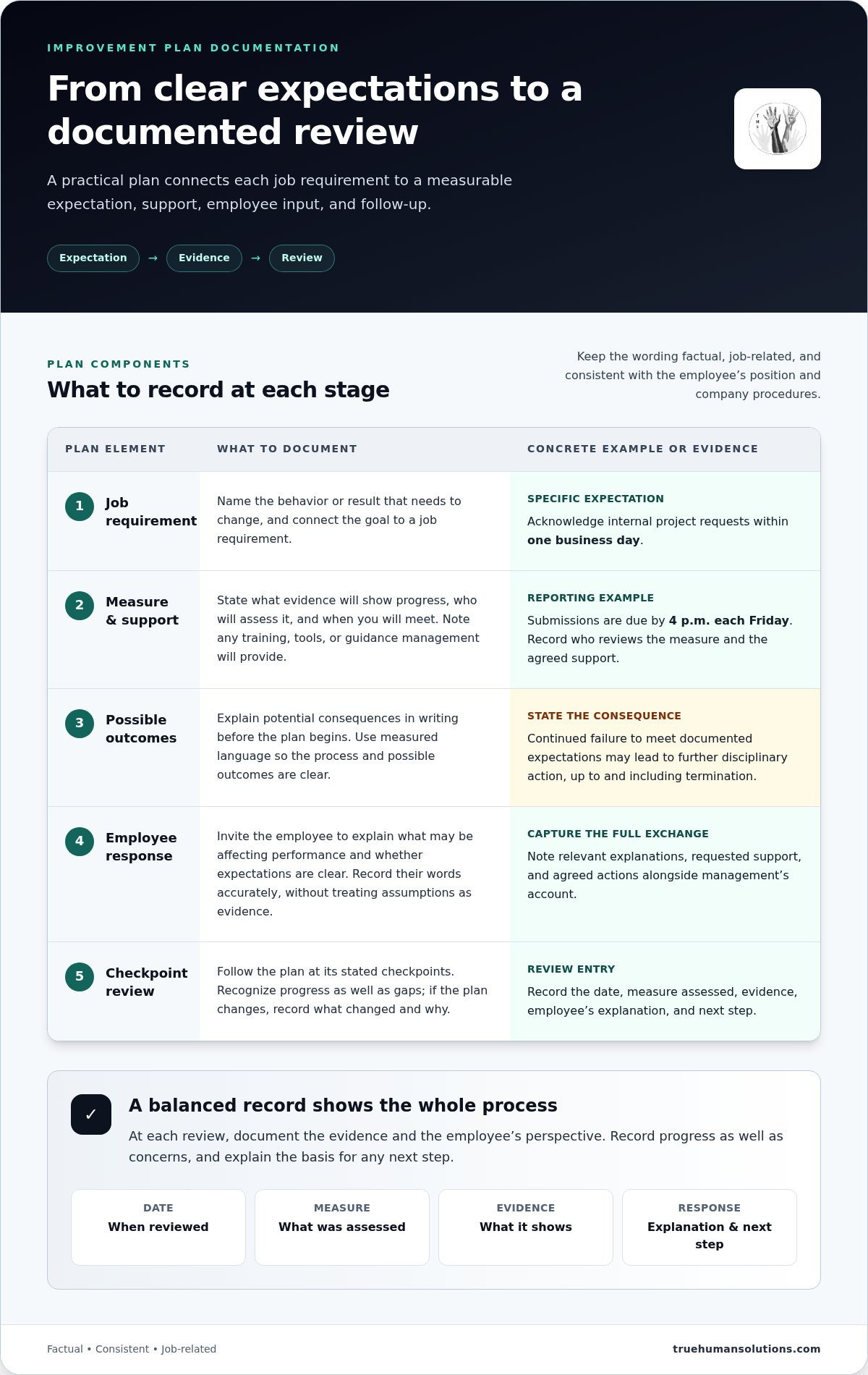
- Connect each goal to a job requirement. Name the behavior or result that needs to change, then state the expected standard. For example, ask the employee to acknowledge internal project requests within one business day. This gives both parties a clear measure, rather than a subjective label such as “poor communication.”
- Set a way to assess progress. Identify what evidence will show improvement, who will review it, and when you’ll meet. A reporting goal might require submissions by 4 p.m. each Friday. Keep the measure consistent with the employee’s position description, and note any training, tools, or guidance management will provide.
- Explain potential consequences in writing before the plan begins. State that continued failure to meet documented expectations may lead to further disciplinary action, up to and including termination. Use measured language, not a threat. The employee should understand the process and possible outcomes before the review, rather than hearing about consequences only after missing a goal.
- Invite the employee’s response and record it accurately. Ask what may be affecting performance and whether expectations are clear. Note relevant explanations, requested support, and agreed actions without presenting assumptions as evidence. A complete record helps distinguish a performance issue from a misunderstanding and supports objective decisions, including when discrimination concerns arise.
- Follow the plan at its stated checkpoints. At each review, record the date, measure assessed, what the evidence shows, and the employee’s explanation. Recognize progress as well as gaps. If expectations remain unmet, explain the next step and document its basis. If the plan needs adjustment, record what changed and why, so the written record reflects the actual process.
Maintaining balanced and confidential documentation
Use records to capture the full picture of an employee’s performance, while limiting sensitive details to appropriate files and readers.
-
Balance Concerns with Positive Feedback
Record meaningful successes alongside performance concerns, using the same factual standard for both. For example, note when an employee completes a project two days ahead of its agreed deadline while meeting quality expectations. Pair that evidence with any separate concern, rather than allowing one event to erase the other. Avoid labels and personal judgments. When documenting employee performance, distinguish direct observations from interpretation, and include the employee’s statements when they explain events or describe helpful coaching.
-
Protect Confidentiality and Privacy
Store employee records in an established, secure system and restrict access to people involved in managing the matter, such as authorized HR staff. Protect sensitive personal information and review access as responsibilities change. Don’t keep separate or secret notes about an employee. Keep formal documentation focused on job-related conduct. If an employee shares personal difficulties, offer appropriate support without recording private details in the performance file. This approach protects privacy while preserving a useful, accountable record.
-
Consider Legal Risks
Review records for factual accuracy, consistency, and job-related language before relying on them for decisions. In the United States, incomplete or uneven records can weaken the explanation for disciplinary action and raise concerns about discrimination or retaliation. Compare how similar situations were handled, and record relevant differences rather than assuming cases are identical. Preserve the employee’s response and evidence supporting management’s account. For sensitive allegations, involve HR and follow the organization’s established process.
Details to include in a workplace timeline
Include the date, people involved, observable events, supporting evidence, impact, and actions taken. In an incident report, describe what happened factually, such as an agreed project submitted two business days late, rather than labeling an employee’s attitude.
-
Record Workplace Timeline Details
Start each entry with the incident date and the date you recorded it. Identify people involved, where the event occurred, what happened, its work impact, and any available evidence. If the exact date is unknown, mark it as approximate; don’t present an estimate as fact. For example, distinguish an entry dated March 5, 2024, from an approximate timeframe.
-
Document Incident Information
Describe the conduct or result in neutral, specific terms, then note the relevant expectation and evidence. For example: “The project was submitted two business days after the agreed deadline; the delivery record shows the submission time.” Avoid turning the event into a judgment about attitude. Documentation can help explain later decisions when it shows the facts, impact, and applicable expectations.
-
Document Employee Conversations
Record when the conversation occurred, who attended, the concern discussed, and what each person said. Where possible, capture the employee’s explanation in their own words rather than presenting your interpretation as fact. Note any policy or document reviewed and the coaching offered. A dated summary preserves what was discussed and helps distinguish the conversation from later recollections.
-
Record Follow-Up Actions
At the agreed review point, record the action taken, outcome observed, and any explanation provided. Note whether the concern was resolved, continued, or required further discussion, along with the next step and responsible person. Add new information as a dated entry; don’t rewrite earlier notes. For consistent workplace records and follow-up, connect with Employee Relations support.
TrueHuman Solutions: The TrueHuman ER Case Framework
TrueHuman Solutions offers The TrueHuman ER Case Framework for situations that need a structured employee relations process. It can help leaders address a sensitive concern with clear scope, documented steps, and attention to the people affected. Consider it when a matter involves multiple accounts, uncertainty about next steps, or a need for greater consistency across case records.
For practitioners developing their approach, the ER/HR Practitioner Mini-Course offers a learning resource. Workplace Investigations can provide a structured fact-finding process when a concern calls for one. Each option serves a different need, from building practitioner capability to addressing a specific workplace matter.
Contact TrueHuman Solutions to discuss an employee relations concern and identify an appropriate next step.
Make Fair Documentation Part of Everyday Practice
Knowing how to document employee concerns is only the beginning. The next step is making fair, careful recordkeeping part of how managers lead, so employees understand how concerns are addressed and decisions are made. Consistency comes from repeated practice, not a single form or conversation.
When a team needs a clearer structure for handling employee relations matters, TrueHuman Solutions offers The TrueHuman ER Case Framework and The Workplace Integrity Framework. The ER/HR Practitioner Mini-Course can support practitioners who want to strengthen their approach. These resources help leaders consider how process, accountability, and the experience of affected people fit together.
Choose a next step that matches the need: strengthen the process, build practitioner capability, or bring structure to a complex employee relations matter. Contact TrueHuman Solutions to discuss a thoughtful way forward. A steady, fair process gives people a clearer path through difficult workplace conversations.
Frequently Asked Questions
What Common Documentation Mistakes Should Managers Avoid?
Avoid reconstructing events long after they happened, silently changing old notes, or presenting hearsay as firsthand observation. Keep corrections traceable by adding a dated clarification while preserving the original entry. Don’t combine unrelated matters in one record. For example, keep a scheduling concern and a customer complaint separate, so anyone reviewing the file can understand the basis for each decision.
What are the Types of Documentation in Employee Relations?
Employee relations records can include performance reviews, coaching notes, attendance records, incident reports, investigation materials, and decision records. Each serves a distinct purpose: a coaching note captures guidance, while an investigation file records fact-finding. Organize records by matter and document type. Keep medical or accommodation information separate from general performance materials, limiting unnecessary exposure of sensitive details.
Why Is Factual Language So Important?
Factual language lets another manager understand events without relying on the writer’s interpretation. “The handoff lacked the required client status field” describes a checkable issue; “careless work” expresses a judgment. For anyone learning how to document employee concerns, this distinction helps keep records useful during later reviews. Identify reported information as such, and separate it from what you directly observed.
Why is Workplace Documentation Important?
Workplace records preserve context when a manager changes roles, memories differ, or an earlier concern resurfaces. They help an organization assess whether its response fits the circumstances and whether comparable situations received consistent attention. A clear record also supports continuity between a supervisor and HR, giving the employee a concrete basis for understanding and responding to management’s position.
How to document employee performance or conduct concerns objectively?
Separate what you observed from the relevant expectation and the employee’s response. For example, note that a handoff field was blank, identify the work instruction, and record the employee’s explanation. Avoid claims about motive unless supported by evidence. Include who observed the issue and when, then retain related messages or work records so a reviewer can assess the account in context.
What are the steps for documenting and addressing employee concerns?
Start by identifying the work issue and gathering relevant records. Speak privately with the employee, hear their account, and clarify the applicable expectation. Then choose a response that fits the facts, such as coaching or further review, and record the decision and next action. At follow-up, assess what changed and whether the matter is resolved or needs continued attention.
