

Employee relations documentation mistakes often start when a record captures a judgment but leaves out the facts: what happened, when, who was involved, what was discussed, and what followed. Strong documentation brings these details together, connects conduct to relevant policies or expectations, and records the employee’s perspective and agreed next steps. Keep records timely, factual, and consistent with how similar concerns are handled.
Writing a record is only the first step. It also needs to be fair, useful, and aligned with policy. This article explains what employee relations documentation includes, how to assess its quality and consistency, and why neutral language matters. It covers common gaps, from vague descriptions and missing follow-up to decisions without a documented rationale, so you can strengthen the process while keeping the people involved in view.
Key Takeaways
- Build records that help a future reader understand the sequence of events and the basis for each decision.
- Review comparable cases and policy references to spot uneven treatment before an action is finalized.
- Replace character judgments with specific, observable conduct and relevant workplace impact.
- Use documentation to guide fair next steps, including employee input, support, and follow-up.
1. What is Documentation in HR and Employee Relations?
Employee relations documentation is the record of performance, conduct, investigations, and disciplinary actions. It should help an employee and a future factfinder understand the reason for a decision. Record the incident, relevant dates, people involved, observed behavior, conversation, and resolution. Include materials shared with the employee and any response they provide. A clear sequence lets readers distinguish documented facts from later interpretations.
Write close to the event, while details are fresh. A useful performance note identifies what happened, when it happened, the work expectation, and its impact. For example, record missed project deadlines discussed at a team meeting on October 10, rather than calling someone “unreliable.” After a verbal warning, add a written summary of the concern, discussion, and next steps. Identify the manager and employee, and note others present.
An improvement plan should link a specific concern to achievable expectations and support. Set out the intended outcome, action steps, timeline, and follow-up dates. For example, a plan might ask an employee to acknowledge internal project requests within one business day. Record any training or guidance provided, then document check-ins and progress. This gives the employee a clear path to improve and shows how the organization followed through.
How long should employers retain employee relations documentation by state? There is no single retention period for every record across states. The appropriate schedule depends on the record type and applicable state requirements. Organize records by category and apply the relevant schedule consistently.
What should employee relations documentation include? Record the dates of incidents and conversations, participants, objective details, relevant expectations, the employee’s input, materials provided, and the resolution or next steps. How should records be stored and access controlled? Use an organized, secure record system, limiting access to people who need the information for their roles. For FMLA medical certification records, the U.S. Department of Labor, Wage and Hour Division says employers must keep them confidential and separate from usual personnel files.
2. Auditing documentation quality and policy consistency
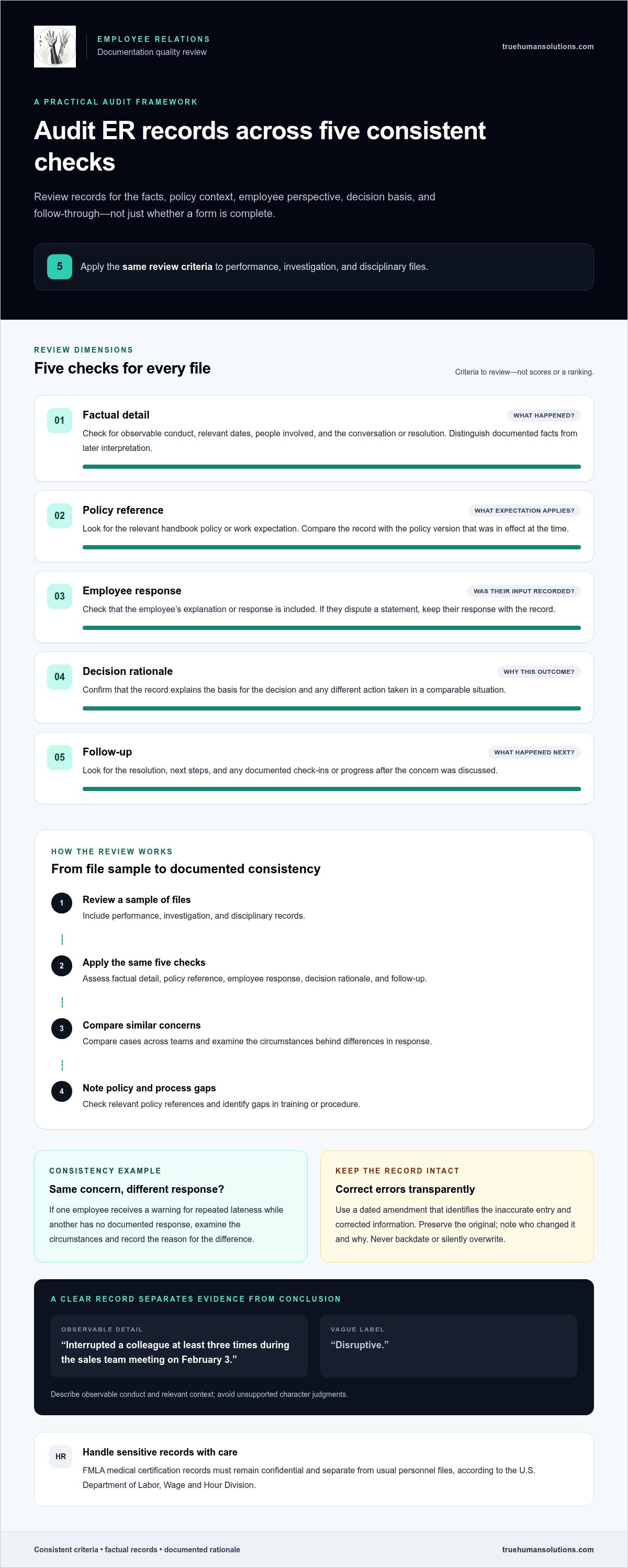
A useful audit checks whether records support consistent decisions, not just whether forms are complete. Review a sample of performance, investigation, and disciplinary files using the same criteria: factual detail, policy reference, employee response, decision rationale, and follow-up. Compare similar concerns across teams, too. If one employee receives a warning for repeated lateness while another receives no documented response, examine the circumstances and record the reason for the difference.
Establish a regular review process with clear ownership. HR can assess whether managers cite the relevant handbook policy, describe observable conduct, and record how concerns were resolved. Compare documentation with the policy version in effect at the time, and note gaps in training or procedure. A record should distinguish evidence from conclusion. For example, “interrupted a colleague at least three times during the sales team meeting on February 3” is more useful than “disruptive.”
What U.S. federal laws govern employee relations records and retention? No single federal law governs every employee relations file; requirements depend on the record type and issue. For example, the U.S. Department of Labor, Wage and Hour Division says FMLA medical certification records must remain confidential and separate from usual personnel files.
Correct an error with a dated amendment that identifies the inaccurate entry and provides the corrected information. Preserve the original record, and note who made the change and why. Never backdate or silently overwrite an entry. If an employee disputes a statement, keep their response with the record rather than treating disagreement as proof of misconduct.
For consistent disciplinary records, apply the same policy-based criteria to comparable conduct, document the facts and the employee’s response, and explain the rationale for any different action. Compare proposed decisions with prior cases before finalizing them. A documented progression can support later review: the U.S. Environmental Protection Agency notes that progressive corrective-action records can help sustain a later proposal for severe adverse action on appeal.
When recurring gaps point to unclear procedures, consistent employee relations processes can help establish clearer expectations for managers and HR.
3. Why Is Factual Language So Important?
Factual language separates observed conduct from a manager’s interpretation. “The report was submitted two business days after its agreed deadline” describes an event and expectation; “careless” assigns a character judgment. This distinction matters when records inform disciplinary action: unsupported labels can obscure the concern and weaken confidence in the process. A clear record states what happened, not what the writer assumes the employee intended.
Use plain English so expectations and consequences are clear. Replace legal-sounding conclusions with the specific workplace rule and conduct: “You left the assigned station before your shift ended” is clearer than “You demonstrated insubordination.” Managers should describe the policy concern and leave legal language or conclusions to HR or legal experts. This boundary helps prevent mistakes such as presenting suspicion as established fact.
Keep the tone neutral, even when the concern is serious. Record the action, relevant context, and effect on the work, distinguishing direct observation from information reported by someone else. For example, write “Jordan reported that the handoff document was missing” rather than “The employee deliberately withheld information” unless the evidence supports that claim. Include the employee’s explanation, too. Fair records preserve relevant perspectives without treating every account as proven.
Before finalizing a disciplinary note, read each sentence as a future factfinder might. Does it describe a verifiable event, identify the expectation, and explain the link to the proposed response? Replace “poor attitude” with specific conduct, such as declining a stated task and the words used, if accurately observed. Remove exaggeration, sarcasm, and assumptions about motive. Objective wording supports consistent decisions while allowing managers to address conduct directly and respectfully.
4. Inadequate employee relations documentation
Inadequate records leave gaps between an incident, the employee’s response, and the employer’s decision. A file that says only “performance concerns” does not explain the behavior, relevant expectations, or action taken. These employee relations documentation mistakes can make it difficult to reconstruct a fair process when a grievance or dispute raises questions. Someone unfamiliar with the matter should be able to follow the record without filling gaps with assumptions.
Common gaps include delayed notes, missing correspondence, undocumented verbal conversations, and absent follow-up. For example, a manager may record that a warning was given but omit its date, policy basis, the employee’s response, or next steps. If notes are added later, show their actual creation date and distinguish it from the incident date. Keep relevant correspondence and contemporaneous notes organized in sequence. After a disciplinary meeting, a written summary and employee acknowledgment can document receipt; acknowledgment does not necessarily mean agreement.
What are the legal risks of inaccurate or incomplete employee relations documentation? Gaps can make it harder to explain why an employment decision was made and whether workplace standards were applied consistently. They may complicate a response to a grievance or legal challenge, particularly if records omit the decision rationale or conflict with other evidence. Inaccurate documentation does not, by itself, determine whether a decision was lawful, but it can weaken the record supporting that decision.
Use a formal correction process when a record contains an error: preserve the original entry, add a dated correction, explain what changed, and identify who made the amendment. Don’t silently overwrite information or backdate a note. For an investigation, retain the reason for each witness interview and the notes taken, distinguishing direct observations from reported information. This gives later reviewers a clearer account of how findings and decisions developed.
If incomplete records are making employee concerns difficult to manage, get support with employee relations documentation and establish a more consistent process.
TrueHuman Solutions: The TrueHuman ER Case Framework
The TrueHuman ER Case Framework gives leaders and practitioners a structured approach to complex employee relations matters. It can help when a concern calls for clear scope, careful process documentation, and attention to the people affected. The framework supports a disciplined approach to organizing a case, while TrueHuman Solutions’ Workplace Investigations support matters that require formal fact-finding.
For broader workplace practice, The Workplace Integrity Framework and the ER/HR Practitioner Mini-Course offer additional tools for strengthening employee relations work. The next step depends on the matter: clarify the concern, identify the process support needed, and keep the record grounded in evidence and fairness.
Contact TrueHuman Solutions to discuss support with an employee relations matter or workplace investigation.
Make the Next Case Easier to Handle
Turn a difficult case into a practical process improvement. Review where the record became unclear, who needed guidance, and which decision points could benefit from a consistent prompt or template. Treat recurring employee relations documentation mistakes as signals to strengthen the process, not as reasons to assign blame before understanding what happened.
For ongoing development, The TrueHuman ER Case Framework, the ER/HR Practitioner Mini-Course, and The Workplace Integrity Framework offer structured resources for employee relations work. Choose based on whether you need to clarify case handling, build practitioner skills, or strengthen workplace practices. A steadier process can support clearer decisions and more respectful conversations.
Contact TrueHuman Solutions to discuss a thoughtful next step for your workplace. You can improve the process one careful decision at a time.
Frequently Asked Questions
What is Documentation in HR and Employee Relations?
HR and employee relations documentation is the organized record of workplace concerns, conversations, investigations, and resulting actions. It may include a complaint intake, meeting notes, relevant correspondence, witness accounts, and a decision record. For example, an investigation file can show how a concern was received, what information was gathered, and how the matter was closed. Together, these records help authorized reviewers understand how the process unfolded.
How Should Managers Document An Improvement Plan?
Managers should turn a performance concern into an observable goal and explain how progress will be assessed. For example, if work contains recurring calculation errors, specify the required accuracy standard, available guidance, and how completed work will be reviewed. Agree on check-in points with the employee, record support provided, and note progress or obstacles. A plan is more useful when expectations are achievable and clear to the employee.
What Common Documentation Mistakes Should Managers Avoid?
Common employee relations documentation mistakes include recording conclusions as facts, omitting context, and changing a record without preserving its history. Avoid phrases such as “always careless”; describe the specific work issue and relevant expectation instead. Don’t record only unfavorable developments while leaving out later improvement or the employee’s response. A balanced record reflects material information, including evidence that challenges an initial interpretation.
When Should A Manager Document A Performance Issue?
Document a performance issue promptly after noticing or discussing it with the employee, while details are still clear. If a concern develops across several work events, record each relevant occurrence instead of relying on a broad retrospective summary. Note when the record was created and distinguish that date from the date of the conduct. This preserves an accurate sequence without implying a later note was written at the time.
Why Are Employee Write-Ups Important?
Employee write-ups create a clear record of the concern raised and the action communicated. They also give managers and employees a shared reference for what needs to change and what follow-up is expected. For instance, after a conversation about incomplete handoffs, a written recap can clarify the agreed process and who will review it. A write-up should support constructive accountability, not replace a conversation.
Why Is Factual Language So Important?
Factual language helps readers distinguish what someone observed from what they inferred. “The employee left before the scheduled handoff” describes conduct; “the employee doesn’t care about the team” assigns motive. This distinction matters during later review, especially when accounts differ. Record what can be supported, identify the source of reported information, and avoid turning uncertainty into certainty. Neutral wording makes a record easier to assess fairly.

