

An effective employee relations case framework starts by assessing the concern’s potential exposure, not by assigning it to whoever is available. Intake captures the concern and its immediate context. Triage then identifies an appropriate owner, sets the handling approach, and establishes how the people involved will be kept informed. This creates a consistent process without treating every workplace concern as carrying the same risk.
A sound process should be fair and well documented. Consistency does not mean every case follows the same path: the response should reflect the concern, the information available, and the potential consequences of mishandling it.
This article explains employee relations case management, from receiving and documenting a concern to assigning responsibility and maintaining communication. It also describes exposure-based case categories, helping leaders and HR practitioners distinguish routine matters from those requiring closer oversight, impartial investigation, or a more deliberate response.
Key Takeaways
- Use exposure and urgency to guide case ownership and oversight, rather than relying on a single response for every concern.
- Record the concern, relevant context, decisions, and actions in a clear, confidential case file.
- Keep communication measured and consistent, and use objective evidence to inform decisions.
- Review recurring patterns and case outcomes to identify where policies, training, or workplace practices may need attention.
Definition and scope of employee relations case management
Employee relations case management is a structured, documented process for receiving workplace concerns, assessing them, assigning responsibility, and recording actions. It may cover grievances, performance issues, workplace investigations, safety concerns, and conflicts between employees or teams.
A consistent process also makes case information easier to review and preserve, and can help identify recurring workplace causes.
Fair Case Management and Trust
Fair case management applies consistent criteria while accounting for the facts and people involved. Employees should be able to see that concerns are recorded, assessed, and handled carefully, rather than dismissed or treated differently without explanation. Managers should keep affected people informed about the process, even when confidentiality limits what they can share. Accurate records of decisions and actions support accountability and make later reviews more reliable. Trust rests on impartial handling and respectful communication.
Preventive Signals and Manager Capability
Recurring patterns can point to unresolved workplace causes, not just isolated incidents. HR teams can review case information for repeated concerns and respond with policy updates or targeted leadership training. Because managers are often the first to notice conflict or dissatisfaction, training can help them listen, encourage formal reporting, and de-escalate concerns appropriately. A case system can support this work when records are scattered across email, progress is difficult to monitor, or pattern reporting takes too much manual effort.
Resolution Timelines and Applicable Laws
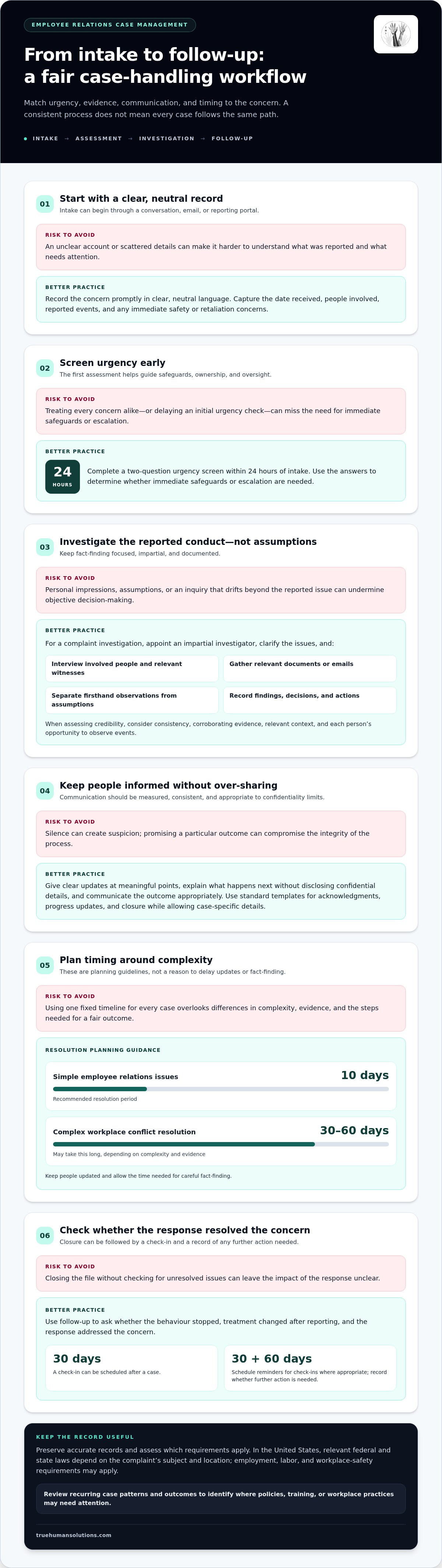
Resolution timelines depend on complexity, evidence, and the steps needed to reach a fair outcome. Simple employee relations issues are recommended for resolution within 10 days; complex workplace conflict resolution may take 30 to 60 days. These periods are planning guidance, not a substitute for timely updates or careful fact-finding. In the United States, applicable federal and state laws depend on the complaint’s subject and location; employment, labor, and workplace-safety requirements may be relevant. Employers should identify the issue, preserve accurate records, and assess which requirements apply before deciding how to proceed. A structured process helps connect each concern to an appropriate response without assuming every case follows the same path.
Communication, training, objectivity, and standardised responses
Communication shapes employees’ experience of a case, from the first update through to the outcome. A structured approach helps HR balance timely information, confidentiality, and consistent treatment.
Consistent Case Communication
Consistent case communication means giving involved people clear, appropriate updates at meaningful points in the process. Silence can create suspicion, while a measured update can explain what happens next without disclosing confidential details. After a resolution, managers should communicate the outcome appropriately and arrange follow-up. Employee-relations teams can set a check-in 30 days after a case to ask whether the behaviour stopped and whether treatment changed after reporting.
Objectivity and Standardised Responses
Objectivity means basing decisions on documented facts rather than personal impressions or assumptions. Standardized response templates help HR communicate consistently in acknowledgments, progress updates, and closure, while leaving room for case-specific details. A consistent process supports fairness, but identical conclusions are not appropriate when evidence and circumstances differ. Accurate case coding also helps teams compare concern types and review patterns over time.
Training gives managers practical ways to recognize conflict, listen actively, and respond without escalating tension. Onboarding should explain how to receive a concern, record relevant details, protect confidentiality, and refer the issue through the correct channel. For example, a manager hearing a complaint should clarify the employee’s concern and explain next steps, not promise a particular outcome. Clear boundaries protect the employee and the integrity of the process.
Feedback after closure can show whether the response addressed the concern or left unresolved issues. Schedule reminders for 30- and 60-day check-ins where appropriate, then record whether further action is needed. Recognition also matters: acknowledging constructive participation can reinforce respectful workplace culture without prejudging findings. Aggregated case analytics can help HR identify recurring themes and consider targeted training or policy changes.
Teams seeking a consistent structure for these practices can explore workplace integrity and case communication as part of their approach to employee relations.
Case intake and documentation
Intake begins when an employee raises a concern through a conversation, email, or reporting portal. HR teams should capture the concern promptly, including the date received, people involved, reported events, and any immediate safety or retaliation concerns. An employee-relations case should receive a two-question urgency screen within 24 hours of intake. The answers help determine whether immediate safeguards or escalation are needed.
For a complaint investigation, appoint an impartial investigator, clarify the issues, interview the people involved and relevant witnesses, gather documents or emails, and record findings and actions. Keep the inquiry focused on the reported conduct, distinguishing firsthand observations from assumptions. When assessing credibility, consider consistency, corroborating evidence, relevant context, and each person’s opportunity to observe events.
- Record the concern: Capture the employee’s account in clear, neutral language, then confirm key details with them.
- Set the scope: Identify the conduct or decision under review and who has authority to handle it.
- Gather evidence: Preserve relevant messages, records, and interview notes, documenting when and how each item was obtained.
- Assess and document: Compare accounts with available evidence, noting what supports or conflicts with each finding.
- Record resolution: Document the decision, actions taken, and appropriate follow-up without including unrelated personal details.
Confidentiality requires limiting access to authorised personnel with a role in handling the case. A secure case system can restrict confidential employee information and preserve an audit trail. In decentralised models with escalation triggers, employee-relations teams should review each new case centrally within 48 hours. This helps identify cases needing different oversight while keeping ownership clear.
Retaliation checks belong in intake and follow-up, not just the final record. Document the employee’s concerns about changed treatment, then note any relevant subsequent reports or actions. A follow-up with the reporter 30 days after the case can assess whether the behaviour stopped and whether treatment changed after reporting. Careful records support a fair resolution and a positive, accountable handling process.
Employee relations case categories and exposure tiers
Exposure tiers group workplace concerns by potential harm, urgency, complexity, and required oversight. They help HR assign appropriate ownership and make proportionate decisions instead of treating every report as equivalent. Categories may include interpersonal conflict, performance concerns, grievances, safety issues, and allegations of harassment, discrimination, or retaliation.
A useful framework distinguishes routine matters from cases needing closer review. For example, a disagreement about meeting conduct may be suitable for manager-led resolution if the facts are clear and no broader pattern is apparent. Repeated complaints involving the same manager, disputed evidence, or potential harm call for stronger HR oversight. Tiering guides how a case is handled; it does not determine findings or replace careful assessment.
- Routine: A first-time communication concern with limited impact may be handled by a trained manager, with HR guidance and a recorded outcome.
- Elevated: Recurring conflict, multiple employees, or unclear accounts may require HR ownership, documented interviews, and review of related cases.
- High exposure: Harassment, discrimination, retaliation, safety concerns, or credible threats warrant prompt escalation and impartial investigation.
Assess concerns about harassment, discrimination, and retaliation promptly and impartially. Preserve relevant evidence and limit access to records to appropriate personnel. HR should consider immediate safeguards, appoint an investigator without a conflict of interest, and document decisions. Follow-up should assess whether the reported conduct stopped and whether the employee’s treatment changed after the report.
Mishandling a case can deepen harm, weaken workforce trust, obscure recurring conduct, and lead to inconsistent decisions. Employers can reduce these risks with clear escalation criteria, manager training on recognizing patterns, and reviews of case records for repeat concerns. For instance, repeated complaints involving one manager may warrant closer review, but are not an automatic finding. Case trends can also inform targeted training and policy changes that support talent retention and a more accountable workplace.
For support with sensitive or recurring employee concerns, explore employee relations support as part of a structured response.
TrueHuman Solutions: The TrueHuman ER Case Framework
TrueHuman Solutions’ TrueHuman ER Case Framework offers a practical structure for handling employee relations cases. It can help HR teams create clearer intake, consistent documentation, and exposure-based triage across workplace concerns. Use the framework to support a repeatable process while keeping the circumstances and people involved in view.
When a case requires impartial fact-finding, TrueHuman Solutions also conducts Workplace Investigations. The ER/HR Practitioner Mini-Course supports practitioner learning, while The Workplace Integrity Framework addresses broader workplace integrity practices. Each offering serves a distinct need, from strengthening case handling to investigating a specific concern.
If your team is refining its approach or managing a sensitive case, contact TrueHuman Solutions to discuss employee relations support.
Put a Clearer Case Approach Into Practice
Turn your employee relations case framework into a working practice by identifying where decisions become difficult: unclear ownership, inconsistent documentation, or uncertainty about when a concern needs independent investigation. Use these pressure points to decide whether your priority is practitioner learning, a stronger integrity structure, or support with a specific case. A focused review can help your team choose changes that clarify day-to-day handling while keeping fairness and accountability central.
TrueHuman Solutions offers The TrueHuman ER Case Framework, the ER/HR Practitioner Mini-Course, and The Workplace Integrity Framework to support different parts of this work. The right starting point depends on whether your team is building capability, strengthening its approach, or addressing a current concern. Contact TrueHuman Solutions to discuss your needs and identify a practical next step. A clear process can give people a steadier, more respectful way forward.
Frequently Asked Questions
What is an employee relations case framework?
An employee relations case framework sets out how an organization classifies concerns, assigns decision-making responsibility, and reviews case handling. It gives practitioners a shared reference when similar reports arise across different teams. For example, it can clarify when a manager may address a communication issue and when HR should take oversight. The TrueHuman ER Case Framework is a practical resource for structuring this work.
What information should an employee relations case intake form collect?
An intake form should capture enough context to understand the concern without asking for unnecessary personal details. Include the employee’s preferred contact method, relevant dates and locations, people who may have information, and records they can identify. A field for the outcome or support the employee is seeking can guide next steps, while a separate space for immediate concerns helps prioritize attention.
How should HR document and manage employee relations cases?
HR should maintain a dated case chronology that distinguishes reported statements, verified records, and decisions made during handling. For example, note when an interview took place, who attended, and whether a summary was shared for accuracy. Use consistent case labels and controlled record versions so reviewers can follow how the file developed. At closure, record outstanding actions and why the matter was considered complete.
What outcomes and corrective actions can result from an employee relations case?
Possible outcomes include mediation, targeted training, a policy change, disciplinary action, or dismissal, depending on the findings and applicable workplace policies. A concern about unclear team expectations, for example, may call for clearer guidance rather than individual discipline. Where evidence supports misconduct, corrective action should reflect the conduct and relevant circumstances. Document the rationale so the response is understandable and applied consistently.
What employee relations case management software and frameworks are commonly used?
Organizations use secure case-management tools to organize records, assign ownership, track progress, and support reporting. Some use broader HR systems with case workflows; others rely on dedicated platforms or a documented manual process. The right approach depends on case volume, confidentiality needs, and reporting requirements. Framework resources, including The Workplace Integrity Framework, can help establish consistent governance alongside the chosen system.
What federal and state laws apply to workplace complaints and investigations in the United States?
Applicable federal and state laws depend on the complaint’s subject and location. Employment, labor, and workplace-safety requirements may apply. Identify the issue, preserve accurate records, and assess the relevant requirements before proceeding.