

A workplace issue is rarely just a policy question. How it is handled can shape trust as well as the outcome. In HR, employee relations covers the working relationship between an organization and its employees, including how workplace concerns, performance, conflict, and responsibilities are addressed. An employee relations course for HR professionals builds the judgment and practical skills needed to manage these matters fairly and consistently.
That work takes more than knowing what a policy says. HR professionals need to listen carefully, separate facts from assumptions, document decisions, protect confidentiality, and recognize when a concern calls for a different process. Clear procedures and humane communication go hand in hand.
This article explains what employee relations means in HR, what effective practice involves, and how training can strengthen performance management, conflict handling, documentation, confidentiality, and role clarity. It also covers what to look for in a course, so you can judge whether the learning applies to the situations you handle.
Key Takeaways
- Build healthier workplace relationships by making communication and expectations clear between employees, managers, and the organization.
- Address performance concerns and workplace conflict through fair, consistent processes that focus on relevant facts.
- Keep records objective and handle sensitive employee information with care and appropriate confidentiality.
- Clarify who is responsible at each stage, and use a structured framework when a concern needs more deliberate handling.
What are the best practices for effective employee relations?
Effective employee relations connects employees, managers, and the organization through clear expectations, fair processes, and timely communication.
Performance Improvement and Discipline
Performance management works best when managers explain the concern, clarify the expected standard, and agree on practical improvement steps. A course should teach HR professionals to distinguish coaching from formal discipline, set measurable expectations, and document follow-up feedback. For example, a manager addressing missed deadlines can clarify priorities, agree on check-ins, and assess progress consistently. Training should also cover how to apply workplace policies consistently across comparable cases.
Grievance and Conflict Handling
Grievance handling starts with hearing the concern without deciding the outcome in advance. Effective employee relations training develops the skills to clarify the issue, gather relevant accounts, determine whether informal resolution is suitable, and escalate concerns that need formal review. Conflict management also depends on clear manager communication: listen without interruption, summarize the concern, explain the next step, and set a follow-up point. These practices support trust and a consistent process.
For US professionals, a useful course teaches practical approaches to performance, discipline, grievances, and conflict, not just theory. The ER/HR Practitioner Mini-Course offers focused employee relations development for practitioners.
Courses may be online, in person, or hybrid, so compare the format with your learning needs. Completion time depends on the course scope and whether lessons are self-paced or scheduled.
SHRM-CP and SHRM-SCP are broad HR certifications, not stand-alone employee relations credentials. SHRM or HRCI recertification credits vary by course, so look for programs that clearly identify applicable credits.
Employee relations learning can benefit HR professionals at every career stage. Before enrolling, review the stated audience and prerequisites. HR generalists moving toward specialization may particularly benefit from applied scenarios.
Strong courses also develop manager communication skills through practice and feedback. Check whether exercises ask learners to explain expectations, respond to employee concerns, and document agreed actions.
Does this course cover performance management and workplace conflict?
Employee relations learning can cover performance concerns, workplace conflict, policies, discipline, and employee wellbeing. Look for practical exercises that connect policy knowledge with fair, consistent handling.
Workplace Conflict Resolution
A useful program teaches active listening, neutral questions, and a clear path from concern to resolution. For example, when coworkers disagree about responsibilities, HR can clarify each person’s account, identify the disputed issue, and consider whether facilitated discussion is appropriate. Course exercises should also help practitioners distinguish routine grievances from allegations that need formal investigation, then explain the next step without prejudging the outcome.
Discipline and Termination
Training should show how workplace policies guide disciplinary decisions, from identifying the conduct or performance concern to documenting the decision. Learners can assess whether expectations were communicated, relevant feedback was provided, and comparable situations were handled consistently. Termination discussions call for particular care: course content should prepare HR to explain the process respectfully, keep accurate records, and focus the conversation on the documented decision.
Policies also affect employee wellbeing. A course should help HR connect procedures for performance, harassment, discrimination, and conflict management with everyday workplace practice. Consider a scenario in which an employee raises a concern while receiving performance feedback: learners should practice separating the issues, hearing the grievance, and documenting the steps taken. This supports consistent handling without dismissing the employee’s experience.
Prevention requires defined reporting routes and clear responses to safety concerns. A report from NIOSH and two other federal agencies records nearly 18,000 workplace-violence deaths over a recent 27-year period. Training can help HR recognize warning signs, follow organizational procedures, and escalate urgent concerns through designated channels.
When a concern calls for structured fact-finding, Workplace Investigations can be a relevant next step.
Documentation, confidentiality, and data handling
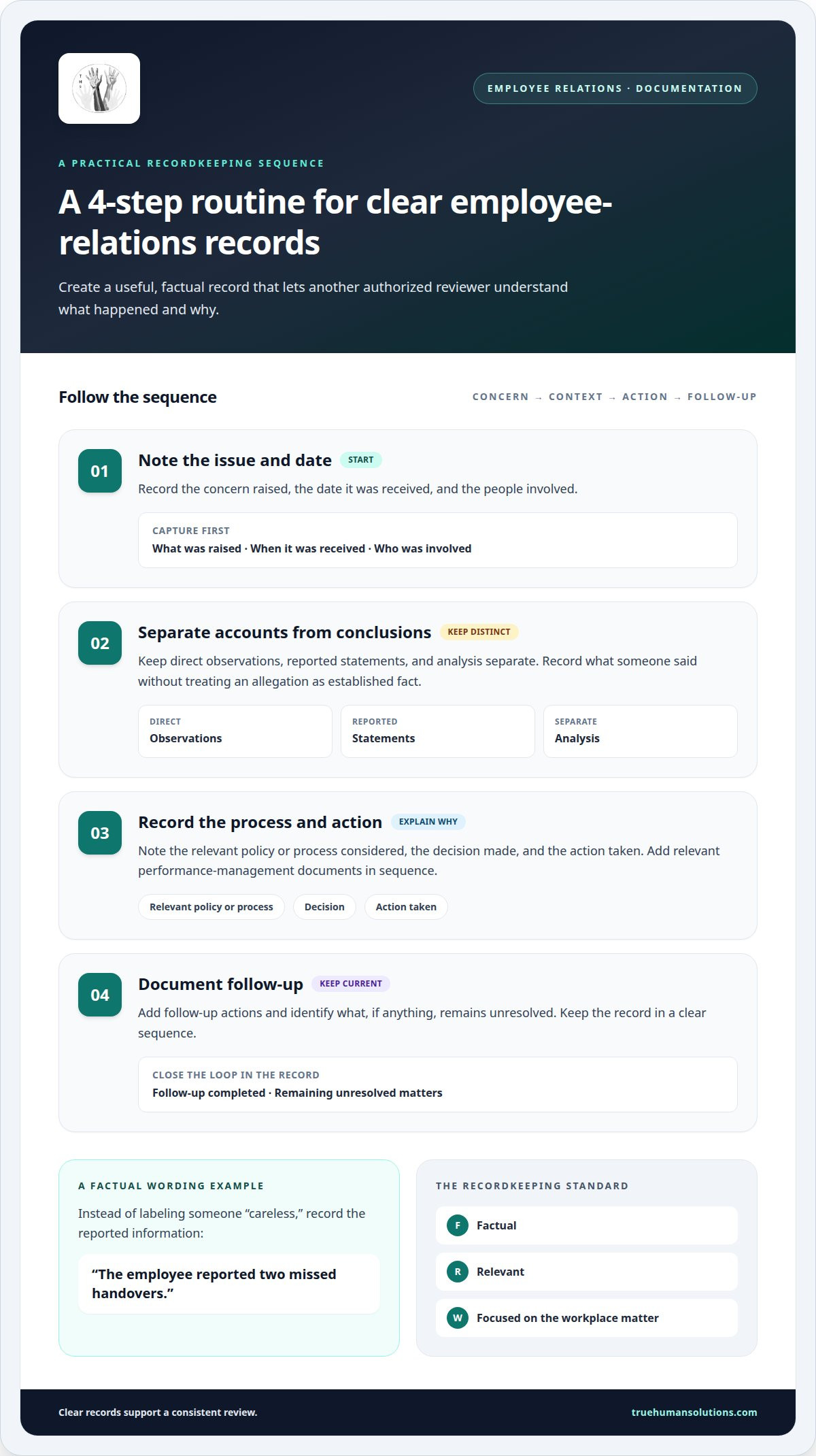
Useful employee relations records allow another authorized reviewer to understand what happened and why. Start with the concern, the date received, and the people involved. Record each person’s account separately from observations or conclusions. For example, write “the employee reported two missed handovers” rather than labeling someone careless. Add relevant performance management documents, decisions, and follow-up actions in sequence. A clear timeline helps leadership understand the process without treating an allegation as established fact.
A practical documentation routine can follow four steps:
- Note the issue raised and the date it was received.
- Separate direct observations, reported statements, and analysis.
- Record the policy or process considered and the action taken.
- Document follow-up, including what remains unresolved.
These practices make records more useful and support consistent review. Keep entries factual, relevant, and focused on the workplace matter.
Confidentiality requires care at every stage. Share sensitive information only with people who need it for an assigned role in the process. Before circulating a summary, remove details the recipient does not need to act. Store notes through the organization’s established channels, and avoid leaving employee information in shared drafts or informal messages. Training should also help HR explain confidentiality boundaries clearly, without promising secrecy that the process cannot maintain.
When comparing courses, look for exercises that build sound judgment with realistic records, such as a manager’s feedback notes or an employee’s written concern. Check whether the learning covers access, accurate recordkeeping, and careful communication, not just form completion. A useful program connects these topics to organizational culture: leaders set an example by documenting decisions consistently and handling employee information with care. Course completion may provide a certificate, but that is different from an independently assessed professional certification. Choose learning that helps practitioners apply sound documentation practices in daily work, then reinforce those practices through leadership guidance and consistent organizational procedures.
Employee relations roles and responsibilities
Employee relations often sits within human resources, supporting workplace relationships and the work environment. Its responsibilities cover both individual concerns and organization-wide practices, rather than belonging to one job title alone. An employee relations specialist may focus on how HR practices support constructive workplace relationships. In smaller teams, HR and managers may share these responsibilities.
HR practitioners coordinate processes, advise managers, and help apply policies consistently. They can clarify which concerns call for informal conversations, formal review, or another organizational process. Managers remain responsible for day-to-day communication, including setting expectations and giving timely feedback. Clear role boundaries help prevent conflicting instructions and unclear updates.
Managers shape employee engagement through practical actions: explain decisions, invite questions, and follow through on commitments. During workplace conflict, a manager can listen to each employee, identify the shared work issue, and refer unresolved concerns to HR. That does not make managers investigators in every matter. A clear escalation path helps them understand their role and its limits.
Employees also contribute by raising concerns through established channels and sharing relevant information. Training can clarify how employees, managers, and HR participate in a process, while distinguishing shared responsibilities from decisions assigned to specific roles. Employee relations training can serve everyone in an organization, from interns to executives. Courses should therefore include examples suited to different roles, rather than assume every learner handles cases directly.
To make responsibilities clear, map each stage: who receives a concern, who assesses the next step, who communicates updates, and who records the decision. Then use the map in manager conversations and team learning. This supports a strategic approach to relationships without making every interaction a formal HR process. Explore The Workplace Integrity Framework as a resource for structuring workplace integrity practices.
TrueHuman Solutions: The TrueHuman ER Case Framework
The TrueHuman ER Case Framework gives HR professionals a structured way to approach employee relations matters. It helps focus the work on understanding the situation, agreeing on scope, documenting the process, and keeping affected people in view. This approach is useful when a concern feels complex, involves several people, or calls for a careful, consistent response.
For learning and broader practice, the ER/HR Practitioner Mini-Course and The Workplace Integrity Framework offer related resources. When a concern calls for formal fact-finding, TrueHuman Solutions also conducts Workplace Investigations. The right next step depends on the issue and the support needed, from practitioner development to a structured response to a workplace concern.
Contact TrueHuman Solutions to discuss how the framework can support your employee relations work.
Make sound judgment part of everyday practice
Training has the greatest value when learning carries into routine decisions. Consider where your team needs more confidence: guiding a difficult conversation, helping managers respond consistently, or deciding how a concern should move forward. Those priorities can shape an employee relations course for HR professionals around the real demands of your role, rather than treating learning as an isolated event.
From there, choose a practical step to reinforce the learning. A manager might use a shared conversation guide, or an HR team might review how it communicates process updates. Small, repeatable practices can help turn sound judgment into a more consistent workplace experience.
If you’re considering training for your team or your own practice, contact TrueHuman Solutions to discuss training. A thoughtful next step can help you build capability with care, clarity, and a stronger foundation for the people involved.
Frequently Asked Questions
What is employee relations in human resources?
Employee relations is the practice of supporting constructive relationships between an organization and its employees. It covers how workplace expectations, concerns, and people practices are handled. For example, HR may help a manager respond to a team member’s concern about changing responsibilities while clarifying the relevant policy and communication path. The focus is the overall employment relationship, not just formal disputes.
How does employee relations training reduce legal risk?
Employee relations training can help reduce process risks by teaching HR and managers to apply policies consistently and keep clear records. For example, documenting specific performance expectations and follow-up can show how a decision developed. Training should also help practitioners recognize when a concern calls for formal investigation or legal review. It strengthens sound practice, but does not replace jurisdiction-specific guidance or determine a case’s outcome.
Specialized ER certificate or broad HR certification?
A specialized course can build focused knowledge, while a broad HR certification covers wider operational or strategic responsibilities. A completion certificate records participation; professional certification generally involves an independent assessment and may include eligibility or renewal requirements. SHRM-CP and SHRM-SCP are broad HR credentials, not stand-alone employee relations certifications. Choose based on whether you need targeted learning or recognition of broader HR capability.
What employee relations skills will I learn?
Relevant learning can strengthen listening, neutral questioning, policy interpretation, and judgment about next steps. A practical exercise might ask you to separate a manager’s assumptions from an employee’s reported experience, then identify what information would clarify the issue. You can also build skills in communicating process updates, recognizing when informal resolution is suitable, and explaining workplace decisions clearly and carefully.
What's the difference between employee relations and labor relations?
Employee relations addresses the broader relationship between an employer and employees, including in non-union workplaces. Labor relations focuses more specifically on the employer’s relationship with unions and collective matters, such as bargaining and administering agreements. For instance, an individual concern about a manager’s communication may fall within employee relations; a dispute about interpreting a collective agreement belongs to labor relations.
What topics are covered in an employee relations course for HR professionals?
Course topics may include performance management, workplace conflict, grievances, discipline, investigations, confidentiality, and employee responsibilities. Some programs also cover compensation and benefits, organizational values, workplace policies, and professional development. Compare the course outline with the situations you handle: an HR generalist may prioritize broad case judgment, while an employee relations specialist may need more practice with structured fact-finding and complex workplace concerns.


